'Drunk vs. Stoned' art
 |
A recent piece in New York magazine's Art section opens with the following thought-provoking salvo:
The New York Times art critic Ken Johnson is writing a book saying that “psychedelic drugs and psychedelic culture have had a deeper, less obvious influence on the art of the past 60 years than has generally been acknowledged.” Johnson doesn’t mean that the intermingling of art and drugs is new; they’ve probably been canoodling as long as both have been around. And his idea isn’t about artists who actually use drugs. Sober-looking work is made by stoners and addled-looking art is made by teetotalers. Van Eyck’s hyperreal paintings are among the most hallucinogenic works ever made. In some ways, all art is a hallucination. Johnson’s idea has to do with the widespread availability and use of psychedelic drugs and the increasingly common understanding of their effects.
This notion has been around for a while. Five years ago, I wrote about a wily show called “Drunk vs. Stoned,” which postulated that “stoned art” is introspective, hypersensitive, detail-oriented, and prone to surprise, spirals, and repetition, while drunk art is outward-looking, impulsive, romantic, and unafraid of messiness and sloppy emotions. Under these criteria, Expressionism is drunk; Pop is stoned. Pollock, Rauschenberg, and Nan Goldin are drunk; Warhol, Johns, and Cindy Sherman are stoned. Johnson’s lens provides an interesting alternative to teleological-stylistic versions of art history. It is experiential rather than detached. Look at John Chamberlain’s crushed-car-part sculptures this way, and you don’t see commentary on consumerism and waste, or formal arrangements of color and line; you see exoskeletal creatures of folded space. Pipilotti Rist’s burning color becomes the morphing of alternative universes, and Matthew Barney’s crawling through Vaseline makes the malleability of space palpable.
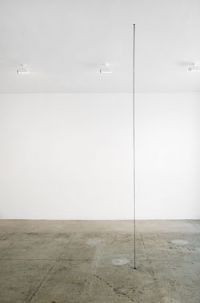
The piece goes on to review an installation of works by Charles Ray, which sound amazing if only for their engineering prowess alone; but I suspect the effect of the installations is well worth investigating judging by these descriptions.
Initially Ink Line looks like a strand of yarn strung the height of the gallery, a pulsating Fred Sandback sculpture, a free-floating Barnett Newman zip, or a disembodied Sol LeWitt. Get close and you’ll realize the line is liquid, glimmering, the consistency of syrup, moving fairly fast, fluctuating slightly, and thinner at the bottom than at the top. The ink forms a weird climatological aura around itself, slightly changing the humidity of the room. I was blown away when I was allowed to see the elaborate apparatus that makes this simple effect possible. There was a large, noisy electric motor in the showroom beneath this gallery, all sorts of wiring, and plastic tubes that go under the floor, behind the wall, and above the ceiling. A gallery assistant arrives two hours early each day to drain the ink, “de-gas” it (!?), heat it with lamps to between 90 and 95 degrees, and put it back into the system. Anyone who looks at Ink Line can figure out how it works—yet the piece is as much a phenomenological event and a mystery as it is a work of formalist sculpture.
|

Recently @ DoseNation
|
|








The comments posted here do not reflect the views of the owners of this site.