'This is Your Country on Drugs'
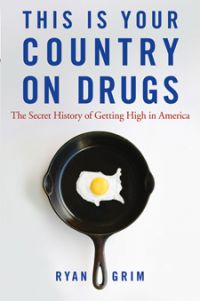 |
Dr. Psilo pointed us to Salon's review of 'This is Your Country on Drugs: The Secret History of Getting High in America', by Ryan Grim.
Not long ago, I was talking with a couple of friends who are about a decade younger than I am. We got onto the subject of recreational drugs and how my friends had recently sworn off Ecstasy. "I know a guy who used to love it, and he's quitting, too," one of them explained. "He's learned a lot about it and says it's just too hard on your body." I remarked that since Ecstasy is the sort of drug most people take only very occasionally, it probably wasn't as dangerous as something like cocaine, which can be addictive, expensive and lethal. "Oh, cocaine's not that bad," said my friend, looking puzzled and leaving me surprised. Hadn't he ever worked for someone who'd gotten so tweaked on coke that he burned out his septum, emptied his bank account and triggered a heart attack? Hasn't every journalist worked with someone like that?
Ryan Grim would understand this disconnect perfectly. One of the theses of his new book, "This is Your Country on Drugs: The Secret History of Getting High in America" -- a cornucopia of unconventional wisdom about our relationship to mind-altering substances -- is that the popularity of drugs waxes and wanes according to a complex sum of factors. One of those factors is the "perceived risk" of using a particular chemical, which also fluctuates. There's a tendency to idealize new drugs, as the Boston Medical and Surgical Journal did with a recently isolated narcotic in 1900. "There's no danger of acquiring a habit," it assured its readers about the drug that had just emerged from the labs of the aspirin manufacturer, Bayer. They named it heroin.
Even when we ought to know better, we don't. "It takes about seven years," Grim writes, "for folks to realize what's wrong with any given drug. It slips away, only to return again as if it were new." I came of age professionally at a time when older journalists and editors were wrecking themselves on cocaine right and left; as a result, I still think of the drug as equal parts perilous and pathetic, as well as hopelessly uncool. My friend, no doubt, came up during a coke lull.
A political reporter who currently works at the Huffington Post, Grim wrote a 2004 article for Slate inspired by a curious observation: LSD, which had been "a fixture of my social scene since the early '90s," seemed to have vanished from that scene. No one he knew was taking it or selling it, and when he approached a drugs-policy researcher for some hard data, they discovered that according to several metrics, acid use was at "an historic low: 3.5 percent." By 2003, it was down to 1.9 percent. Why?
It wasn't just that LSD had gone out of style, although it had, somewhat. Grim found evidence of a perfect storm of causes for the decline. In 2000, the DEA had arrested a man named William Pickard, thought to be the manufacturer of as much as 95 percent of the available acid in the U.S. The Grateful Dead, whose concerts provided an opportunity for suppliers and users to connect and network, had stopped touring after the 1995 death of Jerry Garcia, and Phish, a jam band that had stepped in to fill the gap, also stopped touring by the end of 2000. The rave scene began to fade away under pressure from authorities who threatened to arrest organizers for drug offenses committed at their events.
|

Recently @ DoseNation
|
|







Give me acid or give me liberty.
The comments posted here do not reflect the views of the owners of this site.